How to Practice Golf at Home Without a Garden
A practical, data-backed plan for practising golf at home without a garden. Putting, swing drills, nets, and launch monitors that fit a small space.
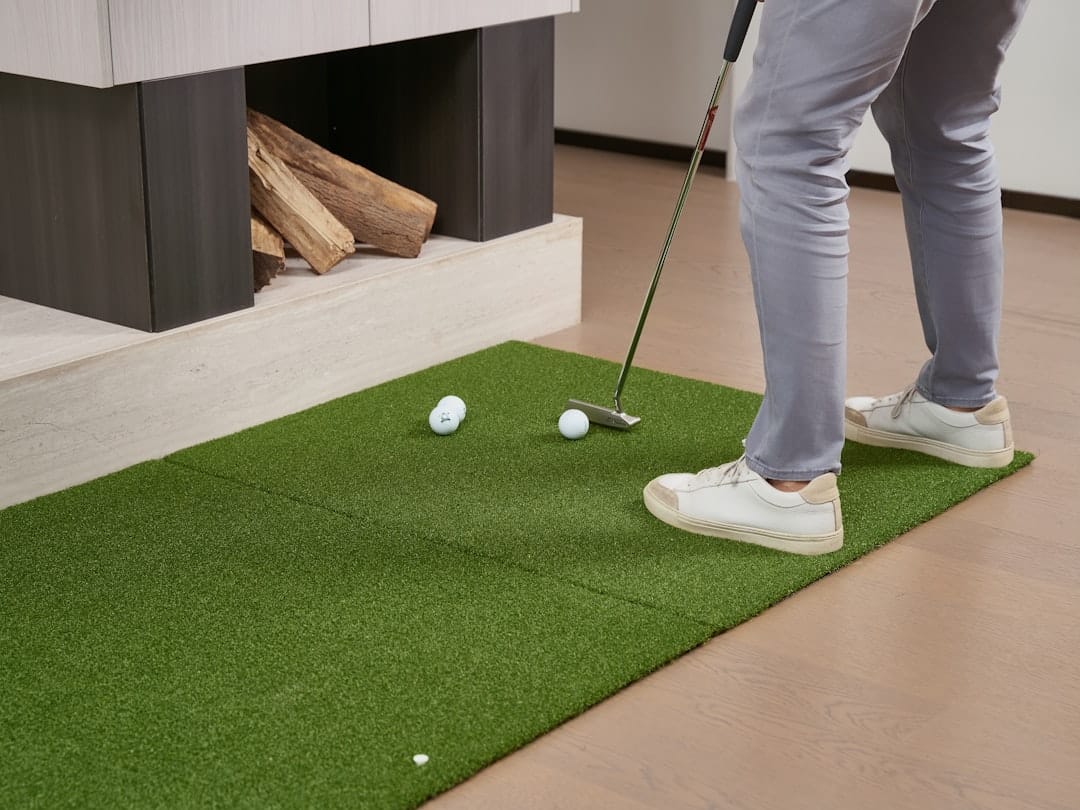
You're a serious golfer living in a flat, a townhouse, or a place with concrete out the back. The range is a 25-minute drive, winter eats four months of the calendar, and the closest thing you have to a fairway is a strip of carpet between the couch and the TV. Home practice gets framed as a consolation prize. It isn't. Stroke mechanics, alignment, grip, tempo, and putting touch are all built indoors. The bits you lose in a tight space are full-swing ball flight feedback and green reading, and there are workarounds for both. This guide walks through what to do, what to buy, and what space you actually need.
- 1.Quick Picks: start with putting and setup work. Both transfer to the course and need almost no space.
- 2.A solid putting mat plus an alignment mirror runs about $60 total and beats most range sessions for stroke quality.
- 3.You need 14 feet (4.3m) of length and 9 feet (2.7m) of ceiling for a comfortable full swing into a net.
- 4.For tight rooms, photometric launch monitors like the Bushnell Launch Pro work where radar units can't.
- 5.Film yourself. The phone in your pocket plus a free app beats most paid coaching tools for self-diagnosis.
Step 1: Assess Your Space Before You Buy Anything
The most expensive mistake home golfers make is buying gear that doesn't fit the room. Before you click anything, grab a tape measure and write down three numbers: ceiling height, room length, and room width. Stand where you'd hit and take a slow practice swing with your driver. If the clubhead clips the ceiling or the back wall, that's your data.
Here are the working minimums by practice method, drawn from Carl's Place's space planning guide (Feb 2026), Garmin's R10 indoor setup notes (2025), and Trackman's January 2026 install spec.
| Practice method | Min length | Min width | Min ceiling | Notes |
|---|---|---|---|---|
| Putting mat | 8ft (2.4m) | 3ft (0.9m) | Standard | Any carpeted room works |
| Air swing with club | 10ft (3.0m) | 10ft (3.0m) | 9ft (2.7m) | Test with your driver before buying |
| Foam ball swing | 10ft (3.0m) | 8ft (2.4m) | 8ft (2.4m) | Safer than real balls indoors |
| Net + mat setup | 14ft (4.3m) | 10ft (3.0m) | 9ft (2.7m) | Minimum for a comfortable full swing |
| Radar launch monitor | 14 to 16ft (4.3 to 4.9m) | 10ft (3.0m) | 9ft (2.7m) | Data quality drops in shorter rooms |
| Photometric launch monitor | 10ft (3.0m) | 10ft (3.0m) | 9ft (2.7m) | Best option for tight spaces |
The split between photometric and radar launch monitors matters more than most people think. Radar units (Garmin R10, Mevo+) need to track the ball flying away from the device for a few feet before they can compute carry and spin. In a 12 foot (3.7m) room, the ball hits the screen before the unit has enough data, and the numbers degrade. Photometric units (Bushnell Launch Pro, SkyTrak) read the ball at impact using cameras, so they don't care about flight distance. If your room is short, photometric is the only sensible option.
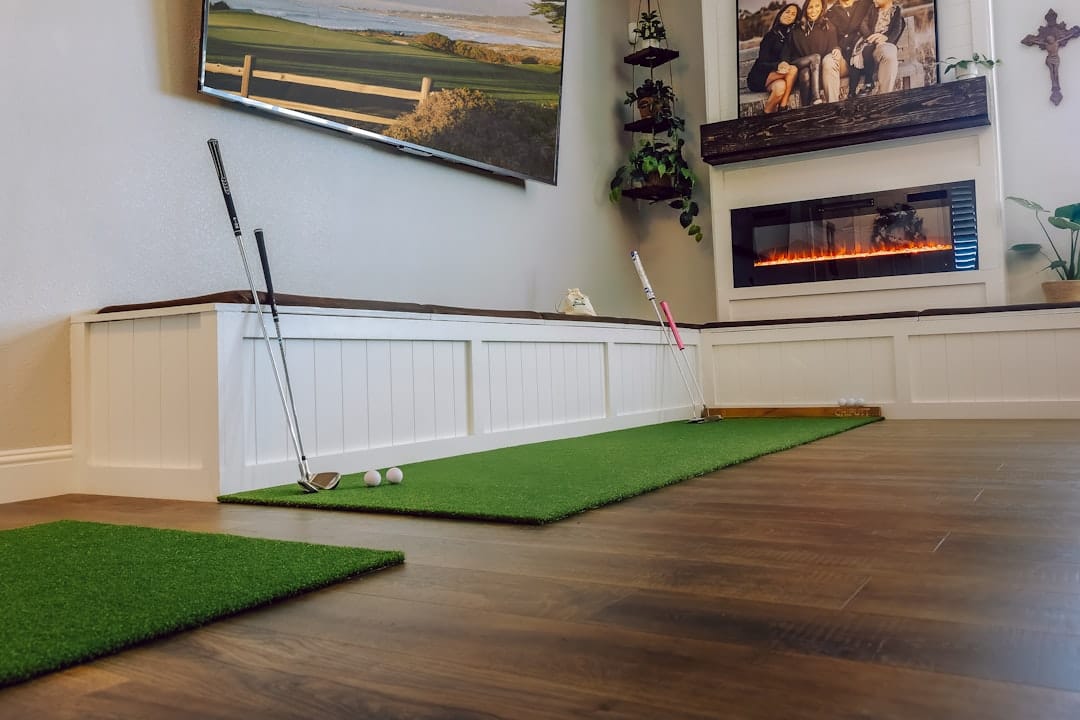
Realistic framing by room type: a bedroom or apartment lounge gets you putting, alignment, and slow-tempo swing work. A spare room (about 12 by 14 feet, or 3.7 by 4.3m) gets you a foam-ball net setup. A garage with 9 foot (2.7m) ceilings and 14 foot (4.3m) of run-up gets you the full thing.
Step 2: Start With Putting (The Highest-ROI Practice You Can Do Indoors)
If you only do one thing indoors, putt. The strokes-gained data is unambiguous. Shot Scope's strokes gained eBook shows that across handicap brackets, scratch golfers average 29.4 putts per round and 25-handicappers average 33.8. That's a gap of 4.4 putts. The handicap difference between those two groups is closer to 25 strokes. Tee shots are the single costliest stroke category by strokes lost per round, according to MyGolfSpy's October 2025 analysis of Shot Scope data. Putting is not where most strokes are lost. So why start here?
Two reasons. First, putting stroke mechanics transfer from indoor practice to the course. Hasegawa et al. (2020) in Frontiers in Psychology found that practice strokes matching the intended motion improve putting accuracy for amateurs. Buenafe's 2024 thesis at CSUN went further: there was no significant difference in final putting performance between players trained in VR and players trained in the real world (p = .861). The stroke is the stroke. Second, 80% of amateur missed greens are missed short, per Shot Scope. If you're missing greens short, you're putting from off the green or from the front fringe. Better putting touch matters there, even if total putts per round looks small.
The honest caveat: green reading does not transfer. You can't practise reading slope on a flat carpet. So indoor putting builds the stroke and the speed control. The reading skill stays a course-only thing.
Putting mats worth buying
For most apartment golfers, the Putt-A-Bout Par Three Putting Mat at $44.99 is the value pick. 4.6 stars across 22,953 ratings on Amazon. Three holes, decent roll, rolls up for storage. It's not tour-grade fast, but it's consistent enough that you can build a stroke against it.
If you've got the budget and the floor space, the Perfect Practice Putting Mat (9'6") at $129.99 is the upgrade. Tour-replica speed, alignment guides, two cup sizes. The smaller cup is hard work, so making one feels like making one.
Three drills that earn their keep
- Gate drill. Place two tees (or two coins) just wider than the putter head, six inches (15cm) in front of the ball. The ball must roll through the gate without touching either tee. This trains face control at impact.
- Ladder drill. Mark spots at 3, 6, 9, and 12 feet (0.9, 1.8, 2.7, and 3.7m). Roll one ball to each in order, then back. The goal is speed control with no lookup.
- Mirror drill. Stand over a putting mirror, set up to a real ball or a coin, and check eye position over the line. Most amateurs stand too far inside the line.
For the mirror drill, the KINGTOP Putting Mirror at $15.66 does the job. EyeLine Golf makes a more durable version if you'll use it every day. If you only mirror-check once a week, the KINGTOP is fine.
Step 3: Grip, Alignment, and Setup Work (Zero Space Required)
The pre-shot routine is where most amateur shots go wrong, and it's all rehearsable in front of a wardrobe mirror. No floor space needed. No swing needed.
A grip trainer takes the guesswork out of hand placement. The SKLZ grip trainer at $33 to $44.99 has moulded finger positions you can hold for 30 seconds at a time while watching TV. Five minutes a day for two weeks rebuilds the feel.
For alignment, the Seticek Alignment Sticks 2-pack at $9.99 is the cheapest piece of training gear that improves your scoring. Lay one on the floor pointed at your target, set your feet parallel to it, and check the gap in the wardrobe mirror. Most golfers are aimed 5 to 10 yards (4.6 to 9.1m) right of where they think they are.
Grip pressure is the other freebie. Use a 1 to 10 scale, where 10 is white-knuckle. Aim for 4. Take five practice grips a day, hold for 10 seconds, breathe out, soften the fingers. Sounds trivial, makes a real difference to release.
Step 4: Swing Training Without Hitting a Ball
This is the bit most home golfers skip, and it's the bit that pays off in tempo and sequencing. You don't need a ball or a net. You need 9 feet (2.7m) of ceiling and 10 feet (3.0m) of clearance in any direction.
The Orange Whip Trainer (full-size, 47 inch model, not the 38 inch Junior, which is a different product) is the tempo tool that keeps showing up in tour bags for a reason. Ten swings a day, eyes closed, feel the rhythm. It exposes any hitch in the transition on the first rep.
The Dr. Gary Wiren Impact Bag at $54.99 trains the impact position. Swing into the bag at 50% speed, freeze at impact, check hands ahead of the ball, lead arm straight, hips open. It teaches the position by force-feedback rather than thought.
Two free drills that need nothing:
- Towel under arms. Tuck a hand towel under both armpits and swing without dropping it. Trains connection between arms and torso. Drop it in the backswing, you're getting handsy. Drop it in the downswing, you're casting.
- Two-club weighted swing. Hold two irons together and make slow, full swings. The extra weight slows you down and forces sequencing. Ten reps each side per session is plenty.
Slow-motion mirror swings are the fifth tool. Stand side-on to a full-length mirror, swing at 25% speed, pause at four checkpoints: takeaway (club parallel to ground), top (lead arm position), impact (hands and shaft lean), follow-through (chest facing target). Two minutes a day rewires the visual model of your swing.
Step 5: Video Swing Analysis (Free and Low-Cost Options)
The phone in your pocket is a coaching tool you've already paid for. Most golfers never use it the way they should.
The V1 Golf app has a free tier with frame-by-frame playback, drawing tools, and a side-by-side comparison view. Swing Coach is a similar option for Android users. Both let you draw swing planes, spine angles, and impact lines on top of your own footage.
Phone setup matters. Two angles are non-negotiable: face-on (camera in front of you, perpendicular to target line) and down-the-line (camera behind you on the target line). Use a tripod or a stack of books at hip height. Hand-held footage is useless because the camera moves. Slow-motion at 240fps is the minimum frame rate for analysing impact. Most modern phones do this.
The mistake here is recording every swing and watching none of them. One thing per session. Pick a checkpoint (e.g. shaft position halfway back), record five swings, watch them, adjust, record five more. That's the loop. Recording 50 swings to scroll through later is just data hoarding.
Video work pairs well with a structured drill schedule. My home practice routine guide lays out a week-long plan that covers putting, setup, swing, and video review across about 90 minutes total.
Step 6: Adding a Net and Hitting Real Balls (If Your Space Allows)
This is where space gets serious. You need 14 feet (4.3m) of length and 9 feet (2.7m) of ceiling at a minimum to swing into a net with a real ball. Less than that, stick with foam.
For nets, the GoSports Golf Practice Net (10 by 7 feet, or 3.0 by 2.1m) at $129.99 is the value pick. Frame holds up, target sheet is replaceable, packs flat. Pair it with the SAPLIZE Foldable Hitting Mat at $26.19 if your floor is concrete or hardwood. Hitting balls off thin carpet onto subfloor is how wrists get hurt.
If your space is too tight for real balls, foam balls let you make full swings with the same swing speed and watch ball flight for the first 8 to 10 feet (2.4 to 3.0m). Almost-Golf foam balls and Birdie Ball are the two formats that fly close to a real ball off the face. Wiffle balls are too light and teach you nothing about strike.
The next decision is whether to add a launch monitor. Without one, you've got a net catching balls and no feedback on what the ball did. Strike feel and sound carry you partway, but most amateurs can't tell a heel strike from a centre strike by feel alone.
For tight rooms (under 14 feet, or 4.3m, of length), photometric is the only real option. The Bushnell Launch Pro Circle B subscription tier at $1,499 works in a 10 foot (3.0m) room because it reads ball data at impact using cameras. The SkyTrak ST MAX at $2,995 does the same job at the next price tier.
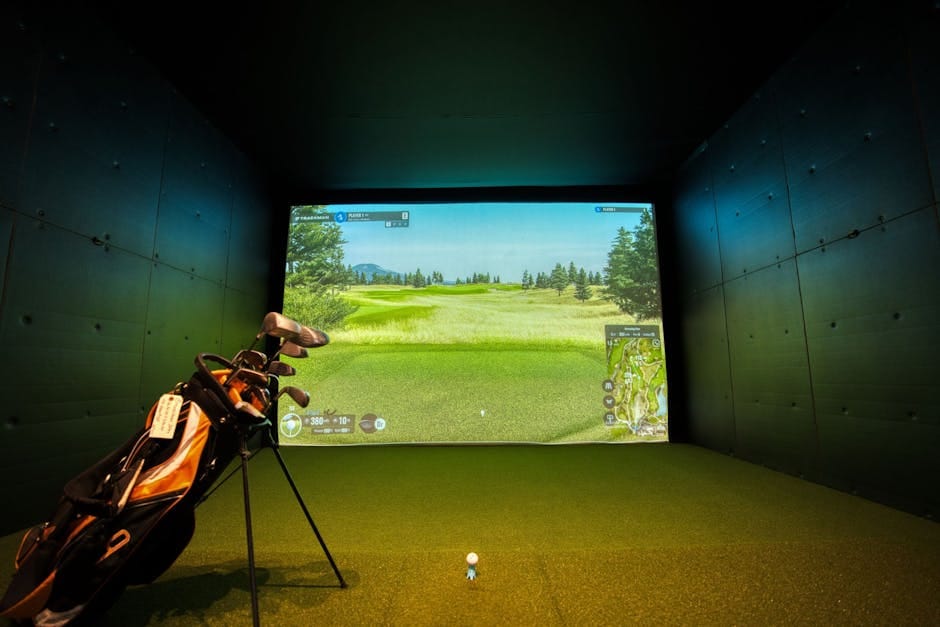
For rooms with 14 to 16 feet (4.3 to 4.9m) of depth, radar units become viable and cheap. The Garmin Approach R10 at around $400 to $599 is the budget benchmark. Below 14 feet, the data quality drops to the point where you'd rather not have it. Garmin's own setup guide states the unit needs the ball to travel a measurable distance to compute a reliable carry number.
For a deeper breakdown of options at this tier, see my roundup of launch monitors under $1,000.
Troubleshooting and Common Mistakes
Five patterns kill home practice progress. Watch for these.
Mindless putting with no drill. Rolling 50 putts at the same hole from the same spot teaches your body to make that one putt. It does not improve your stroke. Every putting session needs a drill structure with a goal: the gate drill, the ladder drill, or a 9-ball game with a count.
Buying a net without a mat. A net catches the ball. The mat protects your wrists and lets you take a real divot motion. Nets without mats turn into "I'll just hit a few off the carpet" which becomes "my left wrist hurts."
Using a radar launch monitor in a too-small room. The data is wrong, you trust it, you change your swing based on bad numbers. The Garmin R10 indoor setup guide (2025) is explicit about this. If you have a tight room, get a photometric unit or skip the launch monitor.
Practising only putting. Yes, putting transfers. So does setup work, swing tempo, and impact position. Spending all your indoor time on the green and none on the swing means you arrive at the course with three months of putting and zero ball-striking practice. Three to one putting-to-swing ratio is fine. Ten to one is a waste.
Recording video but never watching it with intent. See Step 5. One checkpoint per session, watch what you filmed, adjust, refilm. If your camera roll is full of swings you never reviewed, you're not analysing, you're collecting.
Three-putting at home is hard to fix without speed control practice. My breakdown of three-putt causes and drills goes deeper on lag putting in particular.
Frequently Asked Questions
Can you practice golf at home without a garden?
Yes. Putting, alignment, grip, and tempo work all need under 100 square feet (9.3 sqm) and no outdoor space. Adding a net and real balls needs 14 feet (4.3m) of length and 9 feet (2.7m) of ceiling. A photometric launch monitor extends home practice into a complete training environment in rooms as small as 10 feet (3.0m) deep.
How much space do you need for indoor golf practice?
The working minimums by activity: putting needs 8 by 3 feet (2.4 by 0.9m). Air swings with a club need 10 by 10 feet (3.0 by 3.0m) and 9 foot (2.7m) ceilings. A net and mat setup needs 14 by 10 feet (4.3 by 3.0m) at 9 feet (2.7m) ceiling. Radar launch monitors want 14 to 16 feet (4.3 to 4.9m) of depth. Photometric launch monitors work in rooms as short as 10 feet (3.0m).
Does indoor putting practice help your game?
Yes, for stroke mechanics and speed control. Hasegawa et al. (2020) in Frontiers in Psychology found practice strokes matching the intended motion improved putting accuracy for amateurs. Buenafe's 2024 CSUN thesis found no significant difference between VR-trained and real-world-trained putting groups (p = .861). What does not transfer is green reading. Indoor practice builds the mechanical part of putting. The reading part stays course-only.
What is the best indoor putting mat for home practice?
For value, the Putt-A-Bout Par Three at $44.99 with 4.6 stars across 22,953 Amazon ratings does the job. For tour-grade speed and a smaller cup, the Perfect Practice Putting Mat 9'6" at $129.99 is the upgrade. Both roll up for storage in a flat or apartment.
What indoor golf training aids work without hitting a ball?
The four highest-leverage no-ball aids are: an alignment stick set ($9.99 for the Seticek 2-pack) for setup work, a grip trainer ($33 to $44.99 for SKLZ) for hand placement, the Orange Whip full-size trainer for tempo, and an impact bag ($54.99 for the Dr. Gary Wiren) for impact position. All four fit in a wardrobe and need under 10 by 10 feet (3.0 by 3.0m) of clearance.
Where to Start This Week
Home practice won't replace range time. It will replace bad range time though, where you stand on a mat firing 60 balls at no target and call it work. The honest path: spend a week on putting and setup, add the swing drills in week two, film yourself in week three, and only buy a net or launch monitor once the basics are habit. Most golfers reverse that order, drop $1,500 on a launch monitor, and use it twice. Start with a $9.99 alignment stick set and a $44.99 putting mat. The rest can wait.
Some links in this article are affiliate links. If you buy through them, I earn a small commission at no extra cost to you. This never influences what I recommend. I link to gear I'd buy myself.

Get the best golf content, weekly
Join thousands of golfers who get our latest reviews, swing tips, and course guides delivered every week. No spam, ever.