









how-to
How to Hit a Fairway Wood Off the Ground
You can smash a 3-wood off a tee. Put the same club on the turf and the
How to break 80 in golf: the five stats that separate 85-shooters from 79-shooters, backed by Shot Scope data from 870,000 rounds.

Breaking 80 is the wall most amateurs hit and bounce off of. According to Break X Golf data summarized by Will Shaw PhD in February 2026, a 10-handicapper averages 84.6 and breaks 80 in just 9.6% of rounds. A 5-handicapper averages 79.0 and gets there 61.6% of the time. Shot Scope's own user data, reported in Golf Monthly in December 2025, shows that only 20% of its tracked users have ever broken 80 even once.
So if you're sitting in the 82 to 87 range and you can feel a 79 in there somewhere, here's the good news and the bad. You don't need a new swing, more length, or a single birdie. The gap between you and a 79-shooter is five specific numbers, and you're losing strokes on one of them every round. This piece covers what those five numbers are, which one is yours, and how to fix it.
TL;DR
Breaking 80 on a par-72 means shooting 7-over or better. That's it. No magic.
Two ways to get there in a realistic round, with no birdies required:
A typical 85-round has different math. Look at how the round breaks down side by side:
| Stat | Typical 85 round | Realistic 79 round |
|---|---|---|
| Birdies | 0 | 0 |
| Pars | 4 to 5 | 7 |
| Bogeys | 10 to 11 | 11 |
| Double bogeys or worse | 2 to 3 | 0 |
| GIR | 4 to 5 | 7 to 9 |
| Three-putts | 2 to 3 | 1 or fewer |
The core shift is not from bogey to par. It's from double-bogey to bogey, and from one extra GIR per nine. That reframes the project. You're not chasing greatness. You're cleaning up the mess.
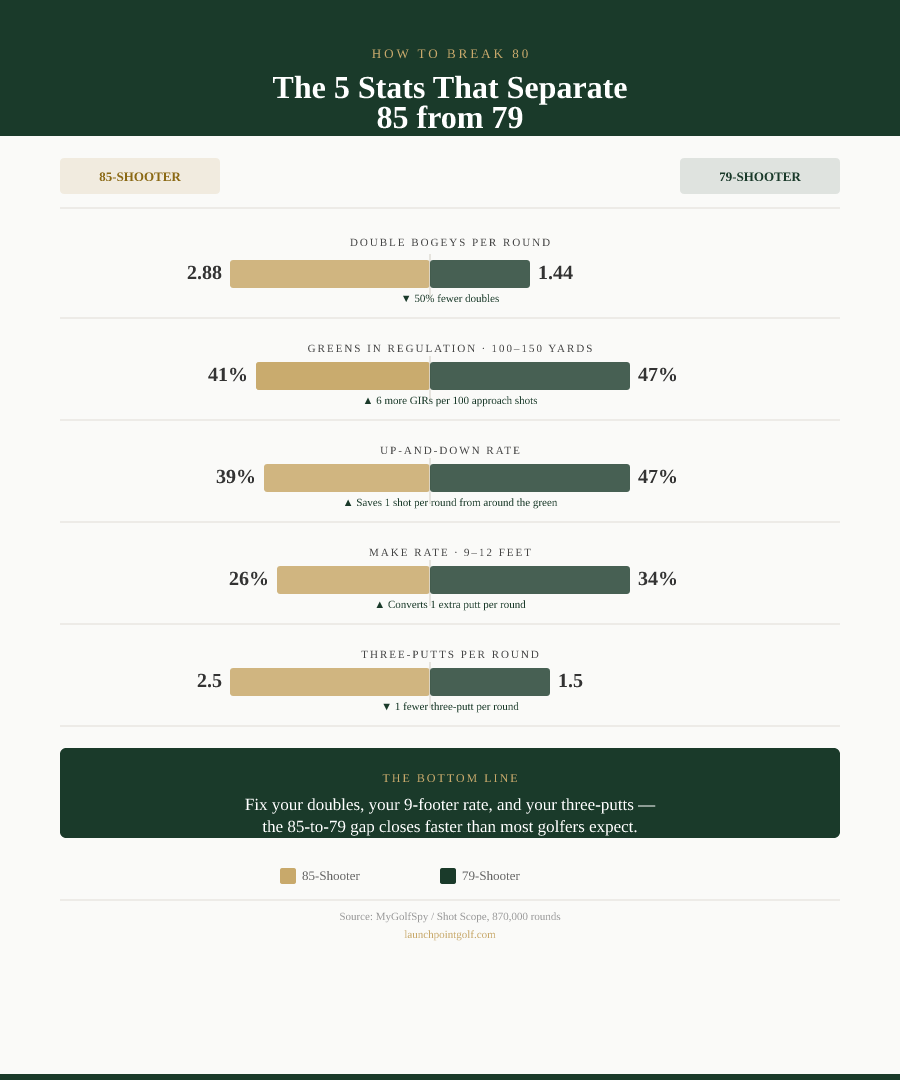
The cleanest dataset on this comes from a March 2026 MyGolfSpy article by Tony Covey, drawing on Shot Scope's database of 74 million shots across 870,000 rounds. The site compared the average 85-shooter to the average 79-shooter and isolated five stats where the gap was widest.
| Stat | 85-shooter | 79-shooter | Source |
|---|---|---|---|
| Double bogeys per round | 2.88 | 1.44 | MyGolfSpy / Shot Scope, Mar 2026 |
| GIR % from 100 to 150 yards (91 to 137m) | 41% | 47% | MyGolfSpy / Shot Scope, Mar 2026 |
| Up-and-down rate | 39% | 47% | MyGolfSpy / Shot Scope, Mar 2026 |
| Make % from 9 to 12 feet (2.7 to 3.7m) | 26% | 34% | MyGolfSpy / Shot Scope, Mar 2026 |
| Three-putts per round | 2.5 | 1.5 | MyGolfSpy / Shot Scope, Oct 2025 & Mar 2026 |
None of those gaps look dramatic in isolation. Six percentage points of GIR. One double avoided. One fewer three-putt. Stack them across 18 holes and they're worth six to eight strokes. That is the gap.
Read each gap as a decision prompt. The double-bogey difference (1.44 vs 2.88 per round) means the 79-shooter avoids catastrophic holes, not that they play cleaner approach shots. The six-point GIR gap from 100 to 150 yards (91 to 137m) is one extra green per round from the scoring zone, the distance where most mid-handicappers take a full mid-iron. The eight-point gap in up-and-down rate means the 79-shooter converts almost half their scrambling chances; the 85-shooter converts fewer than two in five. And the eight-point make rate gap from 9 to 12 feet (2.7 to 3.7m) means the 79-shooter converts one in three of those mid-range pressure putts, while the 85-shooter makes only one in four. None of this requires tour-level ball-striking. It requires a different set of priorities.
The Shot Scope Six benchmarks (MyGolfSpy, October 2025) reinforce the picture. 70s shooters average 9 GIR per round. 80s shooters average 5. One more humbling stat from the same dataset: even a 25-handicapper makes 88% of putts from inside 3 feet (0.9m). The short ones are not your problem. What happens before the short one is.
A 2023 Golf Digest piece by Michael Hutchinson, drawing on Arccos tracking data from 1,000 golfers in the 7 to 9 handicap band, found that 80s shooters cluster into five distinct profiles. They all shoot the same scores. They get there in different ways. Pick the one that sounds most like you. That's where the work lives.
| Type | Profile | Key stat | The fix |
|---|---|---|---|
| A | Iron-limited. Closest to breaking 80. | SG Approach -2.40 | Stop under-clubbing. Stop aiming at pins. Aim at fat parts of greens. |
| B | Contact issues. Good putter, shorter driver. | SG Approach -3.08; driver 224 yards (205m) | Strike quality work. Center-face contact drills. Shorter, in-control swing. |
| C | Strike plane problems. Long off the tee, chunks and thins irons. | SG Approach -2.82; driver 261 yards (239m) | Low point control. Drills targeting bottom of arc. |
| D | If only they could putt. Good ball striker, hands them back on the greens. | SG Putting -3.62; driver 262 yards (240m) | Structured putting practice. Lag putting and 6 to 12 foot (1.8 to 3.7m) zone. |
| E | Blow-up holes. Best iron players in the group, ruined by tee shots and lag putting. | SG OTT -2.75; SG Putting -3.45 | Tee shot management. Lag putting drills. Eliminate the snap hook. |
If you're not sure, two rounds with a tracking app will tell you. Most people guess wrong about which category they're in. The data doesn't.
Strokes gained is a statistical framework developed by Columbia Business School professor Mark Broadie that measures how many shots a player saves or loses compared to a scratch golfer in each category of shot. Broadie's framing, summarized across multiple GolfWRX writeups, puts approach at about 40% of scoring variation. Putting is about 15%.
Approach is the biggest lever. Jon Sherman puts the same idea in plainer terms in The Four Foundations of Golf: "Larger, more sustainable breakthroughs in scoring ability will come from approach shots and tee shots."
Here is the leak. Shot Scope data published in MyGolfSpy in October 2025 shows that 54% of approach shots for a 15-handicapper finish short of the green. Not in a bunker. Not pin-high left. Short. That single fact is doing more damage to your scorecard than your putter ever has.
The scale of the problem is worth sitting with. If a 15-handicapper plays 80 approach shots in a round (a rough par-72 approximation), 37 of them finish on or past the target and 43 finish short. On the holes where the approach falls short, the scrambling sequence starts at a worse angle, from a longer distance, and against a green that wasn't designed to be chipped to from that side. The up-and-down success rate drops accordingly. Shot Scope's October 2025 data shows 80s shooters fail to get up-and-down 60% of the time when they miss greens. Fix the short-of-green miss and you fix the approach stat, the up-and-down stat, and the scoring-zone GIR stat in one move. That is why approach play is the starting point, not a nice-to-have.
Three changes that fix it without changing your swing:
If you do nothing else from this article, do this one. GIR is the single biggest separator in the Shot Scope Six.
85-shooters average 2.5 three-putts per round. Target for breaking 80 is 1.5 or fewer (MyGolfSpy / Shot Scope, October 2025 and March 2026). One fewer three-putt per round is one stroke off your scorecard before any other change.
Three-putts come from one of two things. Either a poor lag (first putt finishes outside the 3-foot (0.9m) circle) or a missed comebacker. The 88% make rate from inside 3 feet that even a 25-handicap manages tells you which one to focus on.
Lag putting is about distance, not line, on anything outside 25 feet (7.6m). The drill is simple. Drop ten balls at 30 feet (9.1m), 40 feet (12.2m), and 50 feet (15.2m). Don't aim for the hole. Aim for a 3-foot (0.9m) circle around it. Count how many finish inside. Track the number. Improve it.
If you want a deeper structural breakdown of where three-putts come from and how to drill them out, the LPG piece on how to stop three-putting walks through it stat by stat.
80s shooters lose 1.4 strokes per round off the tee compared to 70s shooters, per MyGolfSpy / Shot Scope, November 2025. That's a stroke and a half before you've even hit an iron.
The instinct most amateurs have is to swap the driver for a 3-wood when things get tight. The data doesn't support this. Shot Scope's October 2025 numbers show that at the 5-handicap level, fairway-in-regulation rate with a driver is 49%. With a 3-wood it's 51%. Two percentage points. The driver is 20 yards (18m) longer.
Sherman's line on this is the one to remember: "You must prove to yourself that [shorter clubs] are significantly straighter to offset the loss of distance." For most 80s shooters, the proof never shows up. You're giving up 20 yards (18m) for a fairway hit you'd have got anyway.
Three things to do instead:
Inside 70 yards (64m) is where 80s shooters bleed strokes back. Tony Covey's October 2025 piece pegs the gap at 2.7 holes per round where a player needs multiple shots from that range to find the green. The 70s shooters' number is 1.6.
Short game from rough is where the bleed is worst. MyGolfSpy / Shot Scope's November 2025 data shows 80s shooters lose 0.4 strokes per round to 70s shooters from this single situation.
The fix isn't a flop shot. It's safer target selection.
The companion piece on how to chip in golf gets into the contact and technique side. The point here is the strategy: stop trying to be cute.
Sherman puts it in flat terms: "Double-bogey avoidance is a more significant separator in scoring potential than birdies." The Shot Scope data backs him. A 15-handicapper averages 0.36 birdies per round and 4.68 double bogeys (MyGolfSpy, October 2025). The leak is on the wrong end of the scorecard.
Two doubles in a round burn 4 of your 7 available over-par strokes. You then have to play 16 holes at bogey-or-better just to get to 79. That's a brutal ask for any 80s shooter.
The PGA Tour stat is the one I keep coming back to. Tour players, the best in the world, make bogey 80% of the time when they're in a recovery situation (Sherman, The Four Foundations of Golf). They don't try to save par from the trees. They take the bogey and get out of jail. If a Tour pro takes the bogey, you should too. Once you've hit a bad tee shot, your job changes. You're no longer playing the hole. You're playing damage control. The hero shot through the gap is the double.
This single change, taking your medicine, is worth more strokes than any swing fix on the list. Lowering your handicap fast is about removing big numbers, not adding small ones.
The reason most amateurs never break 80 isn't effort. It's diagnosis. They practice the wrong thing because they guess at what's costing them. The fix is data over ten rounds.
For each round, write five numbers on the back of the scorecard:
After ten rounds, average them. Compare to the 79-shooter benchmarks: doubles 1.44, GIR 7 to 9, three-putts 1.5, up-and-down rate 47%. Your worst gap is your bottleneck. Practice that.
If pencil tracking feels like work, a GPS watch will do it for you. Either the Shot Scope V5 (better data dashboards, lower price) or the Garmin Approach S70 (better watch, premium price) records every shot, every distance, every miss. After a month you'll know your real numbers, not your hopeful ones.
Then build your practice around the bottleneck. The piece on building a home practice routine covers how to structure that. The piece on training aids that actually work covers what's worth buying for it.
For most golfers in the 82 to 87 range, six to twelve months of focused work on the right bottleneck is realistic. The Shot Scope data shows the gap is five specific stats, not a general "get better" project. Pick one (the worst of your five), drill it, retest after ten rounds. Without diagnosis, the same player can grind for years and stay at 84.
You don't need one. You do need accurate carry distances for every iron. A one-hour session at a range with a launch monitor (most golf shops rent time on a Trackman or GCQuad for about $50 an hour) gets you the numbers. After that, a GPS watch on the course is enough to track the rest.
Double-bogey avoidance, then GIR from 100 to 150 yards (91 to 137m). The double-bogey leak is mental and strategic, not technical, so it pays off fastest. The GIR gap is where the structural improvement lives over time. Putting matters less than most golfers think, per Mark Broadie's strokes-gained work.
Yes. The Arccos Type B cluster (Hutchinson, Golf Digest, 2023) drives it 224 yards (205m) and sits inside the 7 to 9 handicap band. Distance isn't the gate. Iron contact, double-bogey avoidance, and three-putts are. Tee selection matters more than driver speed at this level. The USGA's 2023 "Best Tees" study found 93% of teaching pros say amateurs play tees that are too long for them.
Lessons, every time. New clubs don't fix the 54% short-of-green miss, the 2.5 three-putts per round, or the recovery-shot doubles. A swing coach who can pull strike-quality data and dispersion patterns will spot your bottleneck in a single session. New irons will not.
The 79 isn't a swing change away. It's five numbers, one of them yours, and a willingness to stop playing the hero shot. Track ten rounds, find your bottleneck, drill that. Then come back and tell me which one it was.
Some links in this article are affiliate links. If you buy through them, I earn a small commission at no extra cost to you. This never influences what I cover or recommend. I link to gear I'd buy myself.
Data-backed reviews and advice that works. No brand spin.