








how-to
Which Tees Should You Actually Play?
* Most amateurs play too far back. Comparing self-reported skill to national driving-distance data shows a big
Cold weather doesn’t stop a round, it changes the routine you use to play one. The physics behind why the ball flies shorter in cold air is covered in depth in our guide to autumn golf conditions; this piece is the practical side, the six adjustments that keep a cold-weather round playable from the first tee to the last green.
A single heavy coat traps warmth but kills your turn. It sits stiff across the shoulders, binds at the elbow through impact, and forces you to make a smaller swing than you think you’re making. The better system is three thinner layers instead of one thick one: a moisture-wicking, non-cotton base layer against your skin, a stretch mid-layer that moves with your shoulders rather than restricting them, and a wind-resistant outer shell you can open or remove as the round warms up. Cotton holds sweat against your skin and gets colder as the round goes on, which is the opposite of what a base layer is supposed to do; a synthetic or merino base stays warm even once you’ve broken a light sweat walking the course.
The mid-layer matters more than golfers usually credit it for, because it’s the piece doing the most work through your backswing and downswing. A mid-layer built with four-way stretch across the shoulders and upper back lets you turn close to your normal range, while a rigid fleece or a cotton hoodie fights you on every swing. Our review of the Callaway Weather Series pullover covers one stretch mid-layer built around this exact requirement, sourced from its published spec sheet and the Amazon aggregate rather than a personal fitting.
No-cost version: a thermal base layer from running or hiking already does the job, since the material matters more than the golf branding. A $15 thermal top under your regular sweater covers most of what a dedicated golf mid-layer promises, and if you already own a stretch fleece or a compression shirt from another sport, it’s doing the same job a golf-labeled version would.
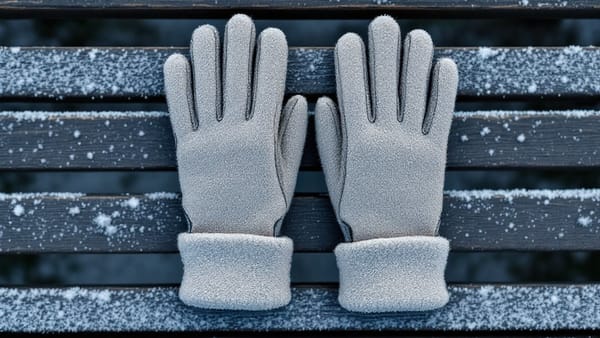
Cold hands lose feel before anything else does, and a stiff, cold hand changes your grip pressure without you noticing it happen. Most golfers grip tighter as their hands get cold, which tightens the forearms and shortens the swing at the same time, and the result is a string of thin and blocked shots that look like a swing problem but start with numb fingers. Our winter golf gloves guide covers glove selection in detail, so this step is about the routine around the gloves rather than which pair to buy.
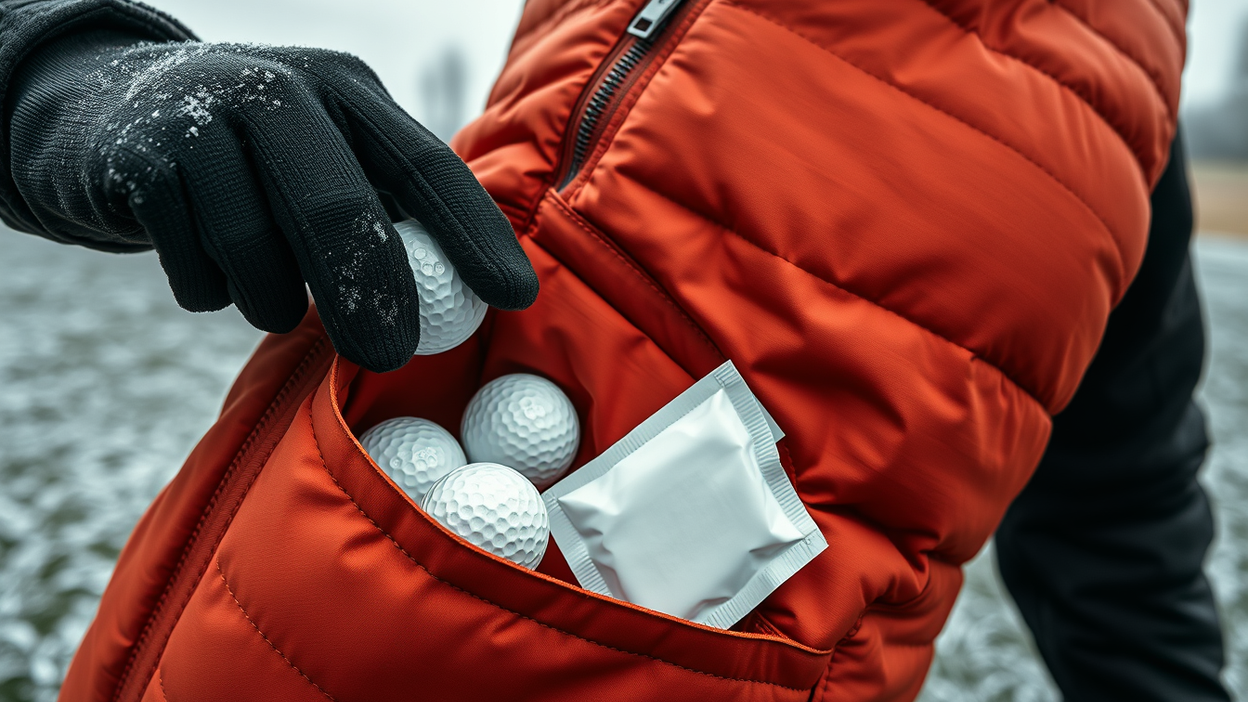
Pair a winter glove with a disposable, air-activated hand warmer tucked into a pocket, and swap in a fresh, warm pair of gloves every few holes rather than wearing one pair for 18 holes straight. A cold, damp glove stops insulating well before the round is over, and a fresh pair restores the grip feel a worn-out one has already lost. Carrying two or three pairs and rotating them, the same idea as rotating golf balls, keeps your hands closer to full feel from the first tee to the last green.
No-cost version: hands in your pockets or tucked under your armpits between shots keeps them warmer than letting them hang at your sides, and it costs nothing beyond remembering to do it. If you already own a pair of glove liners or thin ski gloves for walking between shots, they work as a stopgap while your golf glove stays dry in a pocket.
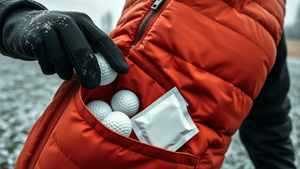
A ball that’s been sitting in a cold golf bag all morning is already working against you before you swing. Golf balls behave differently cold than warm in the same way the surrounding air does: a cold-soaked ball comes off the clubface with less spring, so a warm ball off a cold one is a genuine difference over a full round, not a superstition. Rotate two or three balls in a jacket pocket or a dedicated warmer pouch instead of leaving a full sleeve in your bag, and swap the ball in play every few holes so you’re never hitting one that’s been cold-soaked since the first tee.
The routine is simple: start the round with a warm ball from your pocket, and every three or four holes, swap it for the next one in rotation while the one you just played goes back in against your body to recover some warmth for later. I’ll admit I’m more particular about this swap than most weekend players will bother to be, but it costs nothing but a habit, and the difference shows up most on the shots that matter, the full wedges and mid-irons where feel off the face is easiest to notice.
No-cost version: two pockets and a mental note to alternate every three or four holes gets you most of the benefit without buying a warmer pouch.
Below 50°F (10°C), a golf ball’s core stiffens up, which is the same reason a cold ball off the tee feels and sounds different than a warm one (Snyder Golf USA, June 2025). A stiffer core needs more clubhead speed to compress properly at impact, and most weekend golfers don’t swing hard enough to compress a firm summer ball even in warm weather, let alone a cold one. Our ball compression explainer breaks down what the compression number itself means; the practical version for cold weather is to drop one tier below whatever you play in summer, which helps moderate swing speeds get more of the ball’s energy back at impact instead of losing it to a core that won’t give.
Low-compression options built for this include the Srixon Soft Feel, rated at 60 compression, and the Callaway Supersoft, rated at 47, both in the low-compression bracket for swing speeds under 85 mph (137km/h) that our compression guide covers.
Buy: Callaway Supersoft on Amazon
No-cost version: if buying new balls isn’t in the budget this round, expect the same distance loss and plan your clubbing around it rather than around what the ball does in July.
The physics is straightforward: a driver loses roughly 2 yards (1.8m) of carry for every 10°F (5.6°C) the temperature drops below about 75°F (24°C), and a wedge loses closer to 1.3 yards (1.2m) over the same drop, according to Andrew Rice’s Trackman data reported by GOLF.com. A 40°F (4°C) morning is a 35°F (19.4°C) drop below that 75°F baseline, which works out to roughly 7 yards (6.4m) of driver carry and around 4.5 yards (4.1m) of wedge carry gone before you’ve hit a single shot.
Take the season-adjusted number, one more club than your summer baseline for the same shot, and swing it fully rather than steering a bigger club to try to control the extra distance. This is where most cold-weather mistakes happen: a golfer takes the longer club, then subconsciously eases off the swing to avoid hitting it too far, and ends up with worse contact and less distance than either a full swing with the right club or a full swing with the usual one would have produced. A half swing with more club is close to the worst combination available; commit to the full motion and let the extra club do the distance work.
No-cost version: this step costs nothing beyond trusting the math and picking the longer club, which is the whole adjustment. Choking down half an inch on that longer club, covered in the next step, gives you a touch more control without giving back the swing commitment.
Bulky layers shorten your turn whether you plan for it or not, and fighting that restriction usually produces a worse swing than working with it. Choke down slightly on longer clubs to compensate for the reduced range of motion, and expect a flatter, shorter backswing than you make in short sleeves; trying to force a full summer turn through a mid-layer and a jacket is how a cold-weather round turns into a string of thin and fat contact rather than just shorter shots. A few practice swings before your first tee shot, without a ball, gives you a feel for exactly how much turn the day’s layers are taking away before it costs you a stroke.
Balance is the other casualty of extra clothing. A puffer vest or a thicker jacket adds bulk around your core, which can make you feel less connected through the downswing even when your feet and lower body are doing the same job they always do. Widening your stance slightly and staying a touch more patient on the way down than you would in July helps offset that. None of this is a swing overhaul, it’s a set of small concessions to the extra fabric, and they come off again the moment the temperature does.
No-cost version: choking down and accepting a shorter backswing costs nothing and works with any layering system, not just an expensive one.
Not a special category of ball, but a different compression tier than you’d play in warmer months. Below 50°F (10°C), a ball’s core stiffens, so a lower-compression ball like the Srixon Soft Feel (60 compression) or Callaway Supersoft (47 compression) compresses more easily at impact than a firmer summer ball would.
One club more than your normal number for a given yardage is the standard adjustment, since cold air costs a driver about 2 yards (1.8m) of carry per 10°F (5.6°C) drop below roughly 75°F (24°C). Take the extra club and make a full swing rather than steering a bigger club to compensate.
Yes, and it’s a common pairing. Golfers commonly carry a hand warmer in a pocket and swap gloves back on between holes, using the warmer to top up heat rather than relying on the glove alone.
Yes. A cold-soaked ball is stiffer at impact than one kept warm in a pocket or warmer pouch, in the same way a cold ball off the tee behaves differently than a warm one. Rotating two or three balls between a pocket and play, rather than leaving a full sleeve in a cold bag, keeps the ball you’re hitting closer to its intended compression.
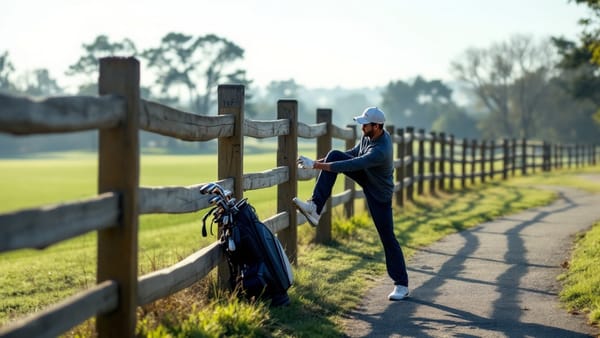
Longer than you would on a warm day. Cold muscles and joints take more time to loosen, so a short walk or a few stretches before your first swing, followed by some practice swings in your actual layers, helps you find your cold-weather range of motion before it costs you a shot on the course.
For the wetter and windier cousins of this problem, see our guides to playing golf in the rain and playing golf in the wind.
Some links in this article are affiliate links. If you buy through them, I earn a small commission at no extra cost to you. This never influences what I cover or recommend. I link to gear I’d buy myself.
Data-backed reviews and advice that works. No brand spin.