







how-to
How to Fix Early Extension in Your Golf Swing
If you've ever topped a drive, thinned an iron, or shanked a wedge and had no
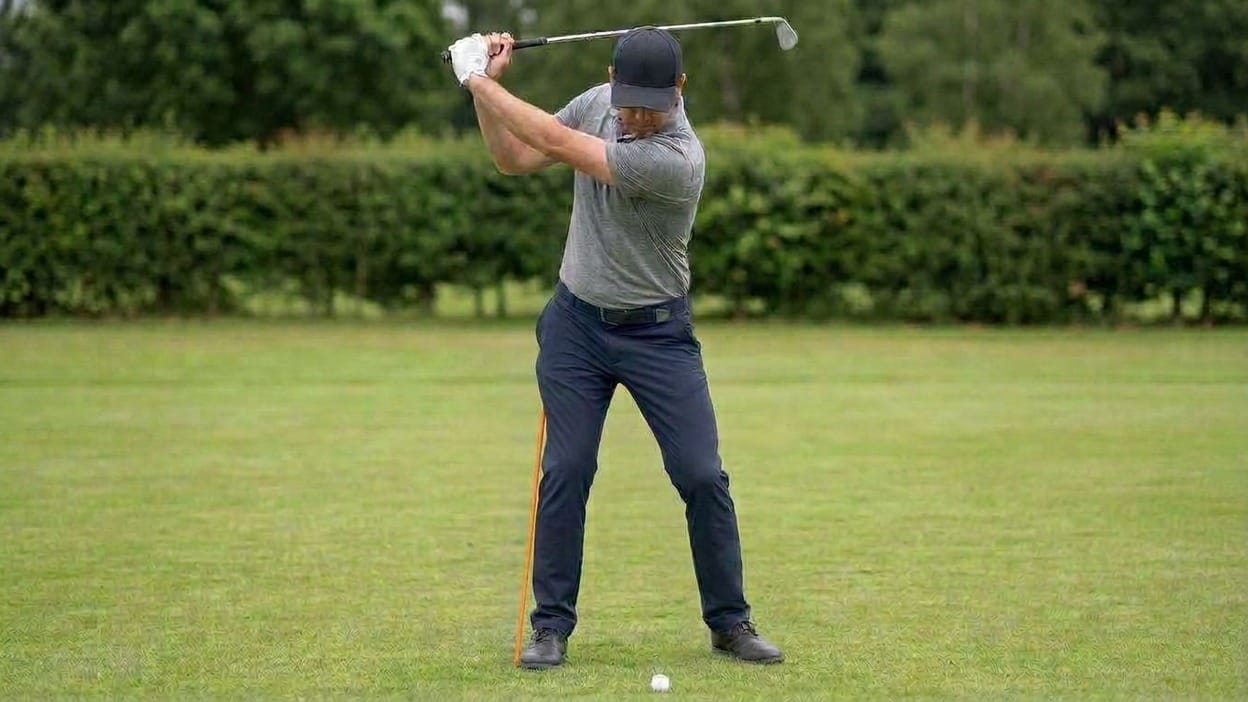
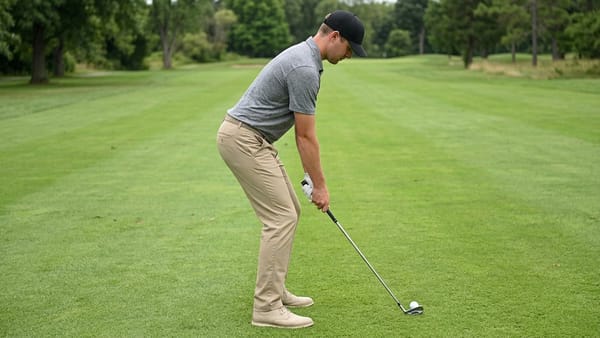
A backswing sway: the hips drift toward the trail side until the thigh crosses the alignment stick.
If a coach ever told you to "shift your weight" and you responded by sliding your hips toward the fence line behind you, you learned the wrong half of a real instruction. Weight does move during a golf swing. The fault is how far your hips and head travel sideways to make it happen, and in which direction that travel runs.
Three faults get lumped together under "swaying," and they aren't the same move.
A sway happens on the way back. The Titleist Performance Institute defines it as "any excessive lower body lateral movement away from the target during your backswing that forces your weight to the outside of your trail side foot." Your hips and head drift away from the target, and your weight ends up stacked outside your trail foot instead of centered over it.
A slide happens on the way down, and it's the one guardrail that matters most here: this site already teaches that a small lead-hip bump toward the target is the correct first move in the downswing, covered in the slice how-to and the early extension how-to. A slide is what happens when that bump doesn't stop. Instead of the hips rotating open once they've cleared toward the target, they keep traveling laterally, drifting past the lead foot rather than turning around it.
Reverse spine angle is a third, separate fault, and it's an upper-body problem rather than a weight-distribution one. TPI defines it as "any excessive upper body backward bend (trunk leaning towards the target) or excessive left lateral upper body bend (for a right-handed player) during the backswing." You can have a clean lower body and still tip your spine toward the target at the top, which is why serious amateurs tend to ask about it separately from a plain hip sway. Both of TPI's definitions lean on the word "excessive," and that qualifier matters. Named sources don't agree on exactly how many inches of lateral movement crosses the line, only that total stillness isn't the goal either, and I stay wary of blanket "stay centered" cues for that reason.
A sway, a slide, or a reverse spine angle all do the same damage to contact: they move the bottom of your swing arc. GOLFTEC's explanation of fat and thin shots puts it plainly: excess lateral movement is what "shifts the swing's low point out of position before the club ever starts down." If your low point moves back, you catch the ground behind the ball and hit it fat. If it moves forward, you catch the ball on the upswing and thin it, or you block it right as your body outraces the clubhead.
That's also why the miss looks inconsistent rather than one repeating shape. A sway that varies by a little from swing to swing moves the low point by a different amount each time, which is exactly the pattern an improver describes when fat, thin, and blocked shots all show up in the same practice session without an obvious cause.
Before buying anything, find out whether you actually sway. Golf Monthly's method needs nothing but a phone: "Any amateur can identify this fault by recording their swing face-on. Stop the video at the top and draw a line along your spine." Set the phone on a chair or bag at hip height, swing normally, and pause the video at the top of your backswing. If your head and upper body have drifted noticeably outside the line you'd draw straight down from where you started, you're swaying.
A club works as the same kind of reference line if you'd rather check it live than on video. Lay a club on the ground just outside your trail foot before you swing, then watch in a mirror or on the paused video for whether your hip or knee crosses over it at the top. Nothing about this check requires a purchase; a stick or alignment rod only becomes useful once you've confirmed the fault exists and want something to swing against during practice, which the drills section below covers.
Some of this starts before the club ever moves. The posture how-to covers how much knee flex to hold at address, and the detail worth carrying into the backswing is that the flex in your trail knee shouldn't straighten out as you turn back. A trail knee that extends is exactly what lets your hips drift outside it, which is the move TPI's definition describes as weight forcing its way "to the outside of your trail side foot." Hold that same flex through the top of your backswing instead of letting the knee straighten.
Stance width plays into this too, though the numbers for it belong elsewhere: the ball-position how-to sets out exactly how wide to stand for each club, and a narrower stance gives your lower body less room to travel sideways before it runs out of base. Check that page rather than guessing at a width here.
The feel that fixes a sway is rotation instead of lateral shift. Joshua Mayo, a Golf Monthly Top 50 Coach, builds his drill around exactly this idea, using an alignment stick planted in a practice bucket as a visual reference while the golfer works "with a club across your chest, just work on getting into this rotated position." The goal his drill reinforces is a backswing where your trail hip turns behind you rather than sliding away from the target, so your trail leg acts as the post you rotate around instead of the direction you lean into.
You don't need the stick to practice the feel itself. Stand with a club across your chest, turn back as if you're starting your backswing, and check that your trail knee holds roughly the same flex it had at address while your trail hip rotates rather than slides. If your head stays over roughly the same spot on the ground while your shoulders and hips turn away from the target, you're rotating instead of swaying.
This is the fault most likely to get fixed wrong, because the correct move and the broken one start in the same direction. GOLFTEC coach Cameron Kelly's cue for starting the downswing is to "gently bump your hips toward the target." That's the same first move the slice how-to and the compress-irons how-to both teach, and the compress-irons piece is explicit that "this doesn't require a dramatic lateral slide." The bump is small, it happens early, and it's immediately followed by rotation, your hips turning open toward the target rather than continuing to travel laterally.
A slide is what happens when the bump doesn't stop. Instead of your hips rotating open once your lead leg has caught your weight, they keep drifting, and your lead leg ends up out past where it started instead of acting as the post you turn against. The fix isn't to remove the bump. It's to let the bump trigger rotation instead of letting it run on.
One drill per fault, and both work without a special trainer.
For the backswing sway, Golf Monthly coach Ben Emerson's fix for one of his students was to give the trail foot something to push against: "To fix the issue, I needed to stabilise Neil's trail foot in the backswing. We achieved this by placing a force pedal (or you can use a tennis ball cut in half) under that foot," with the golfer told to squeeze into it as he swings back. You don't need the pedal; a tennis ball cut in half under your trail foot gives you the same feedback, and feeling pressure into that ball as you turn back is the cue that you're rotating around your trail leg instead of sliding off it.
For the downswing slide, GOLFTEC's No Slide Drill is built "to get your lead knee, or the knee closest to the target, to extend rather than slide forward." Make a slow downswing and pay attention to your lead knee as your hips start to turn: if it's straightening and firming up rather than traveling forward, you're turning around it the way the drill intends; if it keeps bending further toward the target, you're sliding.
Once you've confirmed the fault with the phone check above and want something to swing against during practice, an alignment stick gives you a fixed line to check against on every rep instead of only on video. We cover a set that holds up to daily range use in our SKLZ Pro Alignment Rods review, including a direct link to the set if you decide you want one, and the best golf training aids guide has more options if you want to compare. None of this is required for either drill above.
Sometimes the cue is right and the body can't execute it. If you consistently sway no matter how many reps you spend on the feel above, the limitation may be physical rather than technical: a stiff trail hip or a tight thoracic spine can make rotating around a stable trail leg genuinely difficult, pushing you toward a lateral shift as the only way to complete the backswing. The mobility self-screen how-to walks through checking your own hip and trunk rotation, and the at-home mobility stretch routine gives you a starting routine if a screen flags something. Neither page makes a medical claim, and if a screen turns up pain rather than just tightness, that's a question for a professional, not a drill.
If your scoring goals go beyond fixing this one fault, our Break 100 guide rounds up the course-management and short-game basics that tend to matter more than swing mechanics once you're consistently making contact.
Some links in this article are affiliate links. If you buy through them, I earn a small commission at no extra cost to you. This never influences what I cover or recommend. I link to gear I'd buy myself.
Data-backed reviews and advice that works. No brand spin.