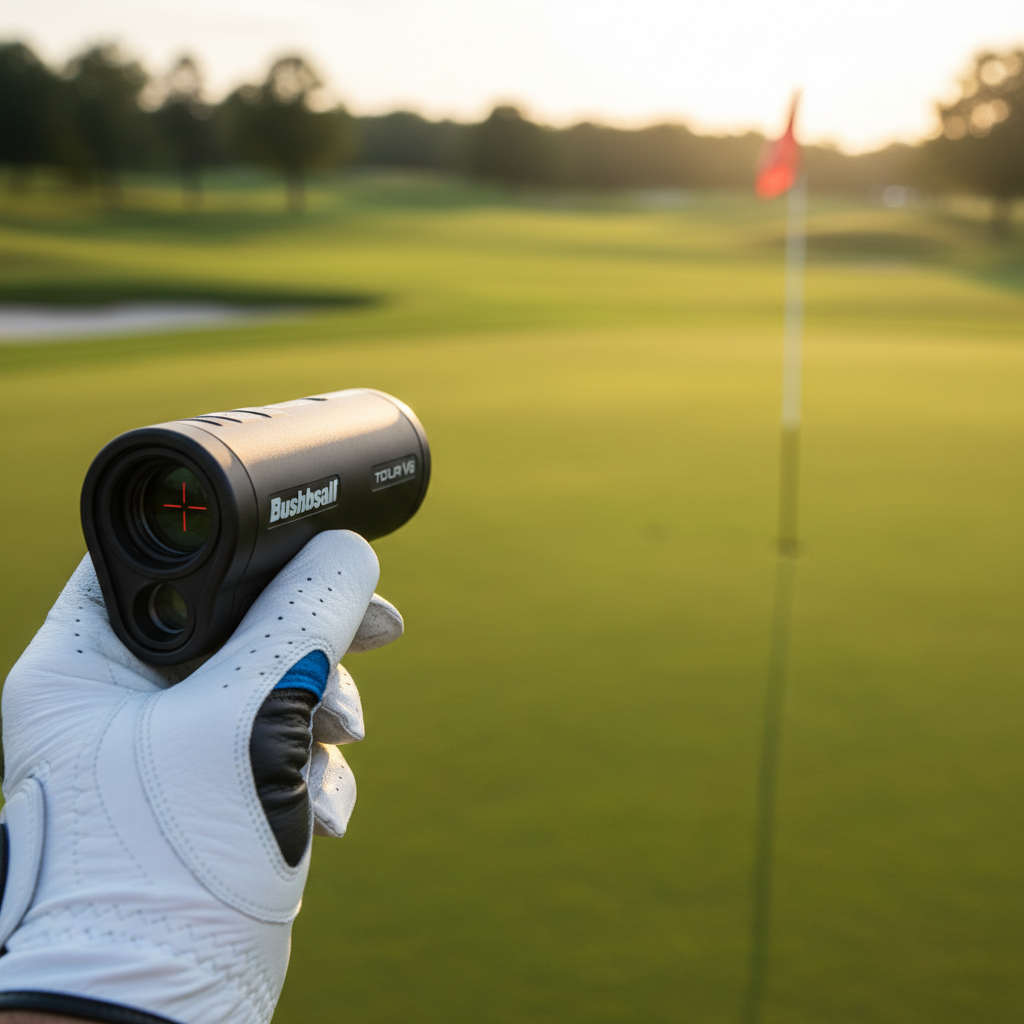
Bushnell's Tour V6 is a laser rangefinder built for golfers who want fast, accurate yardage without carrying a GPS unit. It reads flags at up to 500 yards (457m), locks on with ±1 yard precision, and comes in two versions: a standard model at $299.99 and a slope-enabled Shift model at $349.99. Whether it works isn't the question. It does. What matters is whether the $100 slope premium and the incremental upgrade from the V5 are worth your money.
This review synthesizes independent accuracy data from Golf Insider UK (2024), MyGolfSpy's 2025 rangefinder test, manufacturer specs, and community reports from Reddit's r/golf and r/GolfGear. No personal testing claims. Just the numbers.
The Bushnell Tour V6 delivers ±1 yard accuracy at up to 400 yards (366m) with a fast 0.3-second lock, one of the most consistent readings in its class.
Tour V6 Shift adds slope-compensated distances and is tournament-illegal when slope is active; a switch disables slope for competition play.
Uses a CR2 battery (included, non-rechargeable) with community-reported 30-50 rounds per battery.
The Pinseeker with JOLT vibration confirms you've locked the flag rather than background foliage, a genuine accuracy advantage.
Best value laser for golfers who want precise yardages without a subscription. Not the pick if you want rechargeable battery convenience.
Quick Picks
- Accuracy verdict: The V6 scored 91.2/100 in Golf Insider UK's composite test, with 100% accuracy from 50 to 200 yards (46m to 183m). It's the second most accurate laser they've tested.
- V6 vs V6 Shift: Same optics, same accuracy. The Shift adds slope compensation and a physical toggle for $100 more.
- V6 vs V5: Not worth the upgrade unless your V5 is damaged or you need IPX6 waterproofing for heavy rain.
- Specs snapshot: 6x magnification, ±1 yard accuracy, 8.7 oz (246g), IPX6 water resistance, CR2 battery.
- Best alternative on a budget: The Blue Tees Series 3 Max does the job for $100 less, but accuracy degrades past 120 yards (110m).
What You Get: Tour V6 vs Tour V6 Shift
Bushnell sells the Tour V6 in two configurations. Both share the same optics, the same ±1 yard accuracy, and the same BITE magnetic mount (a magnet built into the housing that sticks to your cart bar). The difference is slope.
Your standard Tour V6 ($299.99) measures straight-line distance to the flag. That's it. Tournament legal in all situations.
For $349.99, the Tour V6 Shift adds slope-adjusted distances, showing you how elevation changes affect your real playing yardage. A physical toggle on the side switches slope on and off. When you toggle slope off, a red indicator ring disappears, and the unit becomes tournament legal. It's mechanical, not software-based, which satisfies USGA Rule 4.3a requirements.
Both models ship with a premium carry case, lens cloth, CR2 battery, and the BITE mount built in.
Both the standard V6 and the V6 Shift now sit below Bushnell's current flagship, the Tour V7 Shift, which adds a dual-color OLED display, Yardage Range Recall, and LINK club recommendations for $399.99. If you want that current-generation feature set, our Tour V7 Shift review covers what the extra tech gets you. The V6 covered here is the budget end of that same lineup: the same core accuracy at the lowest price of the three.
Key Specs at a Glance
Flag range jumped from the V5's 400 yards (366m) to 500 yards (457m). In practice, few golfers need a flag reading beyond 300 yards (274m), but the extended range helps when ranging hazards, layup targets, or doglegs on longer par 5s.
Pros
- 100% accuracy from 50 to 200 yards (46m to 183m) in independent testing
- JOLT vibration + visual ring confirms flag lock, not background objects
- BITE magnetic mount is genuinely useful on a cart
- IPX6 water resistance handles real rain
- Extended flag range to 500 yards (457m)
- Physical slope toggle on Shift model satisfies USGA Rule 4.3a
Cons
- Core accuracy identical to V5: not worth upgrading if your V5 works
- $100 slope premium limited to casual and practice rounds only
- Heavier than alternatives at 8.7 oz (246g)
- Customer service draws mixed reviews on Reddit
How Accurate Is It? The Data
Accuracy is the whole point of a laser rangefinder. If you can't trust the number, you're guessing with extra steps. Here's where the V6 earns its price.
Golf Insider UK's 2024 independent test measured 100% accuracy from 50 to 200 yards (46m to 183m). Flag acquisition rate: 97% to 99% from 30 to 300 yards (27m to 274m). Their composite score: 91.2 out of 100, making it the second most accurate laser rangefinder in their database.
MyGolfSpy's 2025 test evaluated 35 rangefinder models. Both the V6 and V6 Shift received top marks for accuracy and consistency.
One stat worth noting: 98.6% of players at the 2025 Players Championship used a Bushnell Golf laser rangefinder, according to a Darrell Survey cited by Bushnell Golf. That's brand-level, not model-specific, but it tells you where tour-level trust sits.
PinSeeker with Visual JOLT is Bushnell's target confirmation system. When the unit locks onto the flag rather than trees or background objects, it delivers two short vibration pulses and flashes a red ring around the distance readout. You feel and see confirmation at the same time. If you've ever stood over a 175-yard approach wondering whether you ranged the flag or the grandstand behind it, JOLT removes that doubt.
V6 vs V5: Should You Upgrade?
For most golfers, no. Not unless your V5 is broken or you play in conditions where IPX6 waterproofing matters.
What changed between the two generations:
- Flag detection range extended from 400 yards (366m) to 500 yards (457m)
- Optics rated 2x brighter than the V5
- Water resistance upgraded to IPX6 (the V5 had lighter splash resistance)
- Visual JOLT added (V5 had vibration confirmation without the red ring flash)
- Faster flag acquisition speed
What stayed the same:
- Core ±1 yard accuracy
- CR2 battery
- 6x magnification
- Weight class (both sit around 8.7 oz / 246g)
- BITE magnetic mount
Core accuracy, the spec that matters most, hasn't changed. If your V5 still works, keep it. Put that $300 to $400 toward range sessions or a new wedge.
How It Stacks Up Against the Competition
Budget pick: Blue Tees Series 3 Max. Accurate enough inside 120 yards (110m), slope included, and $100 to $200 less than the V6 Shift. If your typical approach is from 150 yards (137m) or less and you don't need lab-grade precision, it's the smarter spend.
GPS data pick: Garmin Z82. It combines a laser with full-color GPS course maps, hazard distances, and plays-like slope data. Steep at ~$600, and independent accuracy data is thinner than what exists for the V6. You're paying for the hybrid approach.
Shaky hands or windy conditions: Nikon Coolshot Pro II Stabilized. Image stabilization helps you hold steady on the flag in wind or if your hands aren't calm. At 6.3 oz (179g), it's lighter than the V6 too. Breaking Eighty's testing showed average accuracy within 0.75 yards.
Best Bushnell without slope: V6 standard. If you play events where slope is banned and don't want to fiddle with a toggle, this is the cleaner option.
Best Bushnell with slope: V6 Shift. Fast toggle, useful slope data for practice rounds, and build quality that matches Bushnell's reputation. I've ranked all of these in my best golf rangefinders breakdown.
What Owners Are Saying
Community feedback from Reddit's r/golf and r/GolfGear (all points below are community-reported, not lab-verified):
What people like:
- Speed. Owners report near-instant flag lock inside 200 yards (183m).
- BITE magnet mount. Golfers who ride carts love this. Stick it to the bar, grab it when you need it.
- JOLT confirmation builds confidence. Several users noted they stopped second-guessing their yardage after switching to a JOLT-equipped model.
- Build quality. Housing feels solid, grip texture holds well in humid conditions.
What people criticize:
- Slope calculation adds about 1 second of delay compared to the near-instant standard lock (community-reported timing, not lab-measured).
- Bushnell's customer service draws mixed reviews. Multiple Reddit threads mention slow warranty responses, which is frustrating given the price point.
- Weight. At 8.7 oz (246g), it's heavier than the Nikon Coolshot Pro II Stabilized at 6.3 oz (179g). Not a dealbreaker, but noticeable over 18 holes if you carry it in your pocket.
Where the Tour V6 Falls Short
No product is perfect, and the V6 has real weak spots.
Incremental upgrade over the V5. The core accuracy hasn't changed. Brighter optics and longer flag range are nice, but they don't solve a problem most V5 owners have. This is a refinement, not a redesign.
That $100 slope premium needs context. USGA Rule 4.3a prohibits slope-measuring devices in any round where the Rules of Golf apply. Not just tournaments. Your regular Saturday four-ball counts if your club enforces the rules. When slope is active on the V6 Shift, an orange background indicator appears in the display, visible to playing partners who glance at your screen. The toggle exists to make slope legal for competition, but the rule applies more broadly than most amateurs realize. You're paying $100 for a feature limited to casual rounds and practice.
Customer service concerns. Multiple Reddit threads document slow warranty processing. Build quality is excellent, but post-purchase support doesn't match it.
Heavier than alternatives. At 8.7 oz (246g), it outweighs the Nikon Coolshot Pro II Stabilized by 2.4 oz (68g). If you carry your rangefinder in a pocket rather than a cart mount, that weight adds up over 18 holes.
Model lineup. Bushnell now sells three tiers under the Tour V name: the standard V6 covered here, the V6 Shift above it, and the V7 Shift above both as the current flagship. Check the listing title before you buy to make sure you're getting the model this review is based on, and see our Tour V7 Shift review if you want the current-generation feature set.
Verdict: Who Should Buy It
Rating: 4.5 / 5
Use this if: You want the most accurate laser rangefinder at the entry-level end of the $300 to $400 price point, and you don't need slope, a color display, or club-recommendation features. Both Golf Insider UK and MyGolfSpy gave the V6 Shift top marks, and JOLT confirmation removes the “did I range the flag or the trees?” doubt that plagues cheaper units. If flag-lock confidence and ±1 yard precision matter more to you than GPS maps or stabilized optics, this is the one.
Skip this if: You already own a working V5 (accuracy is identical). You're on a tight budget (Blue Tees Series 3 Max handles the basics for $100 less). You want GPS hazard data overlaid with your laser reading (Garmin Z82 does that, at a higher price). Or you're looking at practice tech: if you're also considering a launch monitor, the best ones under $1,000 are a better use of that budget. You want Bushnell's current flagship feature set. The Tour V7 Shift adds a dual-color OLED display, Yardage Range Recall, and LINK club recommendations for $399.99. See our Tour V7 Shift review.
Where to buy: The standard Bushnell Tour V6 is available through Amazon. Bushnell also sells the V6 Shift as a separate model with its own review, so check the listing title if you're not sure which version you're looking at.
If you're serious about slope data, start with your strokes gained numbers. Approach shots from 150 to 200 yards (137m to 183m) are where mid-handicappers leave the most strokes on the table. Knowing your adjusted yardage on hilly courses tightens that window.
Frequently Asked Questions
Is the Bushnell Tour V6 legal for tournament play?
Yes. The standard Tour V6 is always tournament legal. The Tour V6 Shift is tournament legal when the slope toggle is switched off, which removes slope calculation and the orange display indicator. The physical toggle satisfies USGA Rule 4.3a requirements. When slope is toggled off, the device functions identically to the standard V6.
What is the difference between the Tour V6 and Tour V6 Shift?
The Tour V6 Shift adds slope-adjusted distance readings and costs $50 more ($349.99 vs $299.99). Both models share the same optics, ±1 yard accuracy, 6x magnification, BITE magnetic mount, and IPX6 water resistance. The Shift includes a physical toggle that switches slope on and off for tournament compliance.
Is it worth upgrading from the Bushnell Tour V5 to the V6?
For most golfers, no. The core ±1 yard accuracy hasn't changed between the V5 and V6. The V6 adds a longer flag range (500 yards / 457m vs 400 yards / 366m), 2x brighter optics, IPX6 waterproofing, and Visual JOLT confirmation. These are refinements, not performance breakthroughs. Upgrade if your V5 is damaged or you need IPX6 water resistance for regular rain play.
How long does the CR2 battery last in the Tour V6?
Community reports from Reddit's r/golf suggest 30 to 50 rounds per CR2 battery, depending on usage frequency. CR2 batteries cost $5 to $8 each. Bushnell doesn't publish an official round count, so these are user-reported estimates rather than lab-tested figures.
How does the Bushnell Tour V6 compare to the Blue Tees Series 3 Max?
The V6 is more accurate past 120 yards (110m), locks onto flags faster, and has a more robust build. Golf Insider UK's 2024 testing showed the Blue Tees accuracy degrades beyond 120 yards, while the V6 maintained 100% accuracy from 50 to 200 yards (46m to 183m). The Blue Tees costs $100 to $200 less and includes slope, making it the better budget pick if most of your approaches are inside 150 yards (137m).
How does the Tour V6 compare to the newer Tour V7 Shift?
The Tour V7 Shift is Bushnell's current flagship rangefinder, released after the V6 and V6 Shift. It adds a dual-color OLED display, Yardage Range Recall, and LINK club recommendations for $399.99. The Tour V6 covered in this review has the same core accuracy at a lower price, but skips those extras and the slope feature entirely. Buyers who want the newest Bushnell feature set should read our Tour V7 Shift review instead.
Some links in this article are affiliate links. If you buy through them, I earn a small commission at no extra cost to you. This never influences what I cover or recommend. I link to gear I'd buy myself.


 Buy now